Limited Artificial Intelligence Program Download Free Microsoft
The term artificial intelligence (AI) refers to calculating systems that perform tasks normally considered within the realm of homo decision making. These software-driven systems and intelligent agents incorporate avant-garde data analytics and Big Data applications. AI systems leverage this knowledge repository to brand decisions and take actions that approximate cognitive functions, including learning and problem solving.
AI, which was introduced every bit an area of science in the mid 1950s, has evolved speedily in recent years. It has become a valuable and essential tool for orchestrating digital technologies and managing concern operations. Particularly useful are AI advances such machine learning and deep learning.
See our list of the meridian artificial intelligence companies
It's important to recognize that AI is a constantly moving target. Things that were once considered within the domain of bogus intelligence – optical character recognition and computer chess, for instance – are now considered routine computing. Today, robotics, image recognition, natural language processing, real-time analytics tools and various connected systems within the Internet of Things (IoT) all tap AI in order to deliver more than advanced features and capabilities.
Helping develop AI are the many cloud companies that offer cloud-based AI services. Statistica projects that AI will abound at an annual charge per unit exceeding 127% through 2025.
Past and then, the market for AI systems will pinnacle $4.eight billion dollars. Consulting firm Accenture reports that AI could double annual economic growth rates past 2035 by "irresolute the nature of work and spawning a new human relationship between human and auto." Not surprisingly, observers have both heralded and derided the technology every bit it filters into business organisation and everyday life.
Also see: AI Jobs
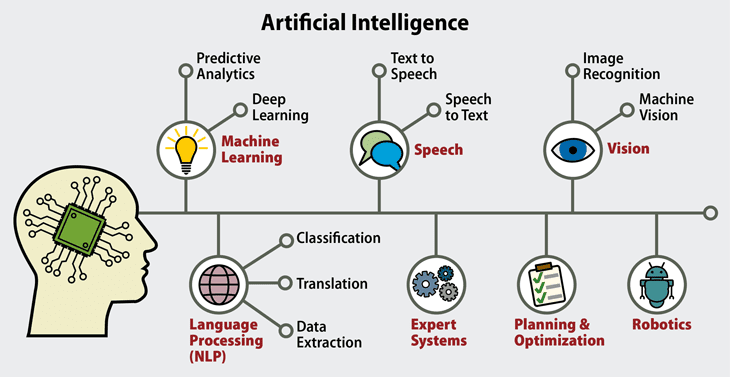
Artificial intelligence has broad applications beyond many areas of business.
History of Artificial Intelligence: Duplicating the Human being Mind
The dream of developing machines that tin can mimic human being cognition dates back centuries. In the 1890s, scientific discipline fiction writers such as H.K. Wells began exploring the concept of robots and other machines thinking and acting similar humans.
It wasn't until the early on 1940s, however, that the idea of artificial intelligence began to take shape in a real way. After Alan Turing introduced the theory of ciphering – essentially how algorithms could exist used past machines to produce machine "thinking" – other researchers began exploring ways to create AI frameworks.
In 1956, researchers gathering at Dartmouth Higher launched the practical application of AI. This included educational activity computers to play checkers at a level that could crush most humans. In the decades that followed, enthusiasm about AI waxed and waned.
In 1997, a chess-playing reckoner developed by IBM, Deep Bluish, beat reigning earth chess champion, Garry Kasparov. In 2011, IBM introduced Watson, which used far more sophisticated techniques, including deep learning and automobile learning, to defeat two top Jeopardy! champions.
Although AI continued to advance over the next few years, observers oft cite 2015 equally the landmark yr for AI. Google Cloud, Amazon Web Services, and Microsoft Azure and others began to stride up enquiry and ameliorate tongue processing capabilities, computer vision and analytics tools.
Today, AI is embedded in a growing number of applications and tools. These range from enterprise analytics programs and digital assistants like Siri and Alexa to autonomous vehicles and facial recognition.
Different Forms of Artificial Intelligence
Artificial intelligence is an umbrella term that refers to any and all machine intelligence. However, there are several distinct and separate areas of AI enquiry and use – though they sometimes overlap. These include:
- Full general AI. These systems typically learn from the world around them and apply information in a cantankerous-domain fashion. For example, DeepMind, now owned by Google, used a neural network to learn how to play video games similar to how humans play them.
- Natural Language Processing (NLP). This technology allows machines to read, empathise, and interpret human being language. NLP uses statistical methods and semantic programming to empathize grammar and syntax, and, in some cases, the emotions of the writer or those interacting with a organization like a chat bot.
- Machine perception. Over the last few years, enormous advances in sensors — cameras, microphones, accelerometers, GPS, radar and more — have powered machine perception, which encompasses spoken communication recognition and figurer vision used for facial and object recognition.
- Robotics. Robot devices are widely used in factories, hospitals and other settings. In recent years, drones take also taken flight. These systems — which rely on sophisticated mapping and complex programming—also use machine perception, to navigate through tasks.
- Social intelligence. Democratic vehicles, robots, and digital administration such every bit Siri and Alexa require coordination and orchestration. As a outcome, these systems must have an understanding of man behavior forth with a recognition of social norms.
Methods of Artificial Intelligence
There are a number of approaches used to develop and build AI systems. These include:
- Machine Learning (ML). This co-operative of AI uses statistical methods and algorithms to notice patterns and "train" systems to make predictions or decisions without explicit programming. Information technology may consist of supervised and semi-supervised ML (which includes classifications and labels) and unsupervised ML (using merely data inputs and no man applied labels).
- Deep Learning. This approach relies on artificial neural networks (ANNs) to approximate the neural pathways of the human brain. Deep learning systems are particularly valuable for developing computer vision, spoken communication recognition, machine translation, social network filtering, video games and medical diagnosis.
- Bayesian Networks. These systems rely on probabilistic graphical models that apply random variables and provisional independence to amend understand and act on the relationships between things, such every bit a drug and side effects or darkness and a light switch turning on.
- Genetic Algorithms. These search algorithms tap a heuristic approach modeled after natural selection. They utilize mutation models and crossover techniques to solve complex biological challenges and other problems.
Uses of Artificial Intelligence
There is no shortage of compelling utilise cases for AI. Here are some leading examples:
Healthcare
Artificial intelligence in healthcare tin play a leading role. It enables health professionals to understand risk factors and diseases at a deeper level. Information technology can aid in diagnosis and provide insight into risks. AI also powers smart devices, surgical robots and Net of Things (IoT) systems that support patient tracking or alerts.
Agronomics
AI is now widely used for crop monitoring. It helps farmers utilize h2o, fertilizer and other substances at optimal levels. It likewise aids in preventative maintenance for farm equipment and information technology is spawning democratic robots that pick crops.
Finance
Few industries have been transformed by AI more than finance. Today, quants (algorithms) trade stocks with no homo intervention, banks make automated credit decisions instantly, and financial organizations apply algorithms to spot fraud. AI too allows consumers to scan paper checks and make deposits using a smartphone.
Retail
A growing number of consumer-facing apps and tools support image recognition, voice and natural language processing and augmented reality (AR) features that allow consumers to preview a piece of furniture in a room or role or see what makeup looks like without heading to a physical store. Retailers are besides using AI for personalized marketing, managing supply chains, and cybersecurity.
Travel, Transportation and Hospitality
Airlines, hotels, and rental car companies use AI to forecast need and adapt pricing dynamically. Airlines also rely on AI to optimize the use of aircraft for routes, factoring in weather condition conditions, rider loads and other variables. They can also understand when aircraft require maintenance. Hotels are using AI, including image recognition, for deploying robots and security monitoring. Autonomous vehicles and smart transportation grids also rely on AI.
Benefits & Risks Artificial Intelligence
For businesses, information technology'south not a question of whether to use AI — many organization already taps into information technology on a daily basis —information technology's a question of how to maximize the benefits and minimize the risks.
Every bit starting bespeak, it's essential to know how and where AI can improve concern processes and build a workforce that understands what artificial intelligence is, where it fits in and what opportunities information technology offers. This may require workers to accept new knowledge and skills – and AI salaries are competitive – along with a rethinking of service providers, workflows and internal processes.
Bogus intelligence serves upward other challenges. Ane of the biggest stumbling points for AI, including machine learning and deep learning, is poorly constructed frameworks. When users train models with bad data or construct flawed statistical models, incorrect and fifty-fifty dangerous outcomes often follow.
AI tools, while increasingly piece of cake to apply, require data science expertise. Other of import factors include: ensuring there's enough computing ability and the right cloud-based infrastructure in place, and, mitigating fears well-nigh job loss.
In whatever case, bogus intelligence is introducing bold opportunities to create smarter and more powerful machines. In the years ahead, AI will certainly further transform business and life.
DOWNLOAD HERE
Posted by: madridbrint1981.blogspot.com


0 Comments